
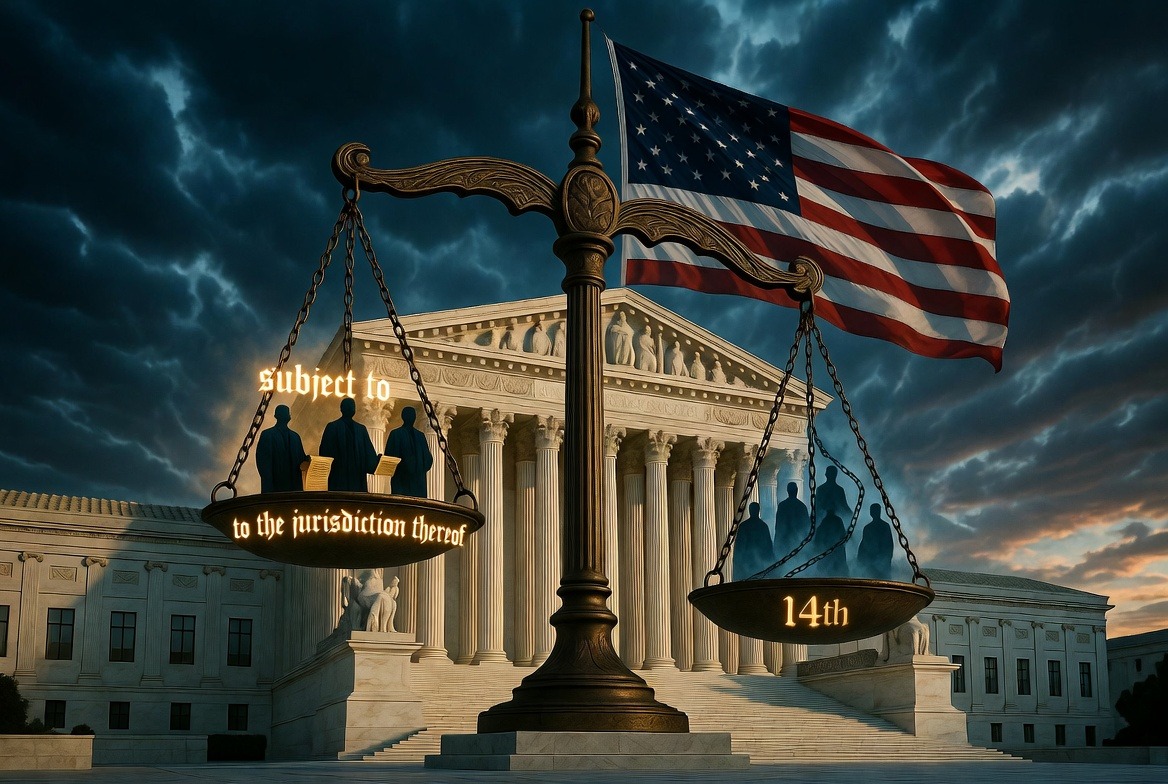
On June 30, 2026, the United States Supreme Court issued its ruling in Trump v. Barbara. In a 6-3 decision, the justices struck down President Donald Trump’s executive order that had sought to end birthright citizenship for children born to parents who were unlawfully or only temporarily present in the United States.
Chief Justice John Roberts wrote the majority opinion, holding that the Fourteenth Amendment’s Citizenship Clause guarantees citizenship to virtually anyone born on American soil who is “subject to the jurisdiction thereof”—including the children of illegal immigrants and temporary visitors. The Court reaffirmed the broad reading from United States v. Wong Kim Ark (1898), declaring the executive order incompatible with constitutional text and history.
The conservative justices refused to join this expansion. Their dissents were clear, rigorous, and rooted in original understanding—precisely the approach the majority abandoned.
Justice Clarence Thomas, joined by Justice Neil Gorsuch, authored a lengthy and devastating dissent. Thomas argued that the majority’s historical account was inaccurate. The Fourteenth Amendment and the Civil Rights Act of 1866 were enacted to secure citizenship for freed slaves—people who were domiciled in the United States, owed no allegiance to any foreign power, and had no other homeland. Neither the Amendment nor the statute was intended to grant citizenship to children of foreign nationals who were not domiciled here or who owed primary allegiance elsewhere. Thomas warned that the Court had once again “repurposed” the Fourteenth Amendment for political projects the Reconstruction Congress never contemplated.
Justice Samuel Alito separately dissented, calling the majority opinion a “serious mistake.” He contended that the Clause confers citizenship only on those who, at birth, owe sole allegiance to the United States. Children of illegal immigrants and birth tourists, he argued, do not meet this standard. Alito rejected the notion that mere physical presence on U.S. soil automatically severs foreign ties or confers full membership in the political community.
Justice Gorsuch added his own dissenting voice, aligning closely with Thomas and questioning whether the majority’s logic could even be consistently applied.
These dissents represent the better reading of the Constitution. They honor the Amendment’s original purpose, respect national sovereignty, and recognize that citizenship carries duties as well as rights. The majority chose instead to lock in a policy that weakens the rule of law and burdens future generations.
The Court’s ruling will stand for now, but the conservative dissents provide the intellectual foundation for correction—whether through constitutional amendment, congressional legislation clarifying the meaning of “subject to the jurisdiction thereof,” or a future Court willing to revisit the issue with greater fidelity to text and history. American citizenship deserves better protection than the majority afforded it on that June day in 2026.
Comments
One response to “Supreme Court’s Citizenship Ruling Betrays Our Sovereignty”
This, is not merely a legal dispute over immigration policy.
It is a decision about the meaning of American citizenship, the consent of the governed, and whether the Constitution can be twisted to reward illegal entry and foreign birth tourism.